
Featured Case Study
Refining EFL Instruction with Constructivist Pedagogy
A learning designer’s journey to amazing outcomes — told through the data.
The Centerpiece
The Anatomy of an Empowered Classroom
A NotebookLM synthesis of 59 real student evaluations from my classes at Hanyang University (2010–2016). It reads seven years of teaching data as the footprint of a trauma-informed educator — and shows how basic and constructivist pedagogy produced near-perfect evaluations across nursing, engineering, and dance alike.
Generated with NotebookLM from 59 sourced student evaluations · Hanyang University, 2010–2016
Across hundreds of evaluations, the single most recurring word is confidence.
What the Data Shows
Three Pillars of a Trauma-Informed Classroom
Pillar 1
Trust
Absolute predictability — an accurate syllabus, strict attendance, guaranteed make-up classes. When the environment is safe and structured, the brain stops scanning for threats and starts learning.
4.68/5
Syllabus reliability
Pillar 2
Choice
Restoring student agency through constructivism. In “English Writing with Multimedia,” students shot, edited, and published their own video blogs instead of sitting exams — a psychological release valve.
“the dream class”
Student reflection
Pillar 3
Collaboration
Deliberate social learning. Group multimedia projects meant students couldn’t succeed alone — neutralizing the cutthroat, isolating atmosphere of high-level academics.
“close to each other”
Student reflection
Confidence
The single most recurring word across seven years of evaluations.
The Full Story
A Learning Designer’s Journey
01
Seoul, 2012
Introduction
In 2012, my journey to develop a blended English-as-a-Foreign-Language (EFL) course in multimedia writing at Hanyang University, Seoul, Korea, began. Originally grounded in traditional educational models, this project transformed into a profound learning and instructional-design awakening — marking the start of my evolution into a learning designer.
02
The Starting Point
Background
Commissioned by the College English Education Committee (CEEC) and with my academic future at the University of British Columbia (UBC) in view, I was initially blind to the shift toward constructivist instructional design. My early course proposal, rooted in objectivist principles, aimed at straightforward content delivery via Web 1.0 technologies — neglecting the interactive and collaborative potential of constructivism.
03
A Radical Shift
The Awakening
My perspective shifted radically after commencing studies in the Master of Educational Technology program at UBC, particularly through courses like ETEC 510 and 532. These experiences illuminated the importance of learner interaction, community engagement, and the role of learners in co-constructing knowledge — forcing a comprehensive reevaluation of my course-design strategy.
04
Web 2.0
Redesigning for Constructivism
Embracing a constructivist approach, I integrated Web 2.0 technologies to foster peer interaction and community building. Through research I discovered that students from traditional educational backgrounds deeply valued and benefited from constructivist environments — leading to asynchronous discussion platforms, collaborative projects, and student-driven content creation that fundamentally reshaped the course framework.
05
In Practice
Implementation & Outcomes
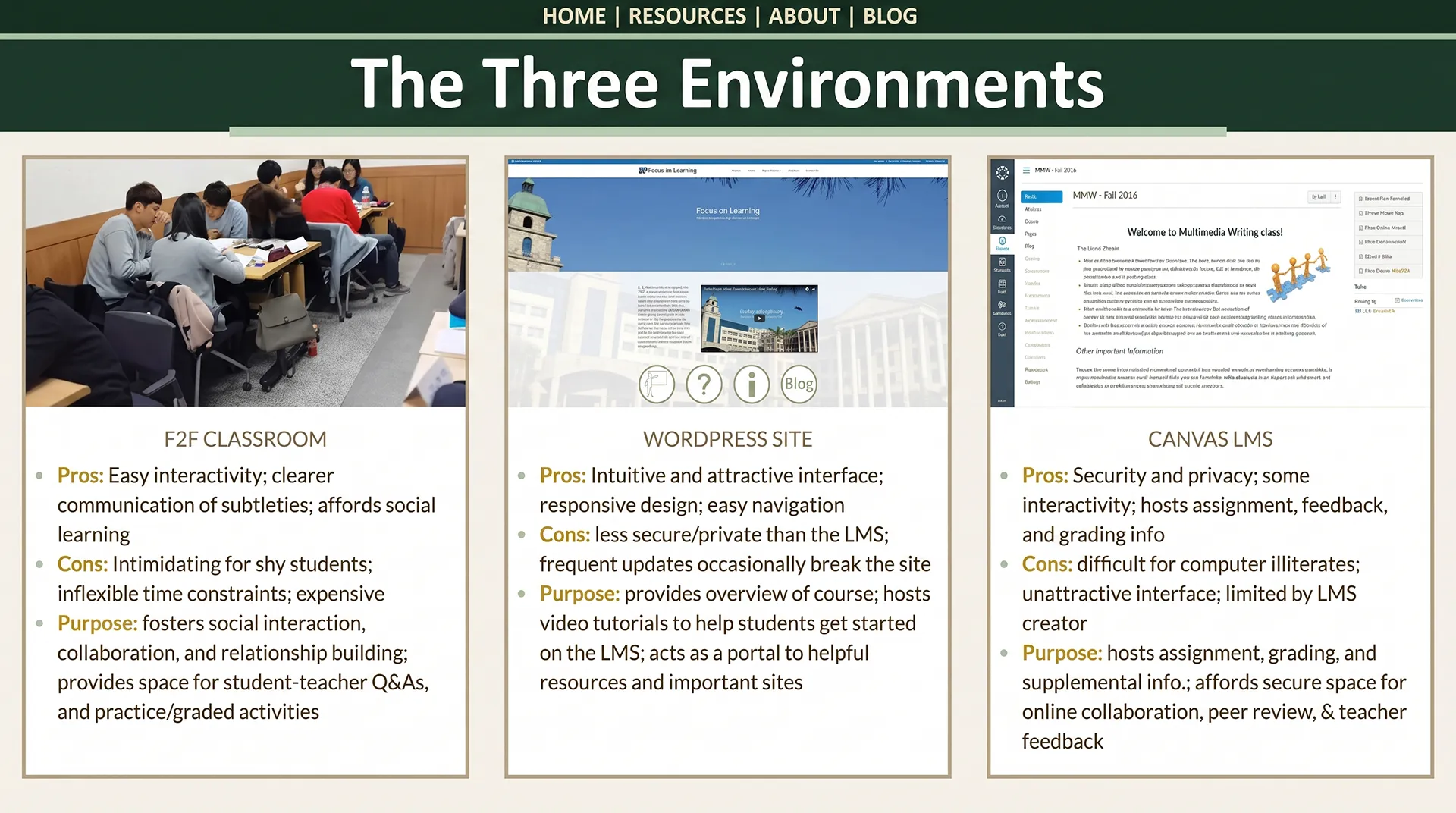
With the revised course in place, I made real-time adjustments based on student feedback. The emphasis shifted toward project-based learning, collaborative work, and real-world learning artifacts. Positive feedback at the semester’s end validated the transition from traditional to constructivist methods.
06
Looking Back & Forward
Reflections & Future Directions
Reflecting on this transformation, it’s clear that adopting a constructivist framework not only enriched student learning experiences but also shaped my approach to instructional design. The ongoing success of the multimedia writing course has solidified my belief in the power of constructivism — interactivity, collaboration, and community building.
07
The Takeaway
Conclusion
This case study underscores the significant, positive impact that constructivist pedagogy had on both the multimedia EFL course at Hanyang University and on my development as a learning designer. Transitioning from traditional models to a learner-centered, interactive approach lets us craft educational experiences that prepare students for real-world challenges.
In the Students’ Words
The Heart of the Classroom
Student reflections on compassionate teaching, synthesized from the same evaluation corpus.
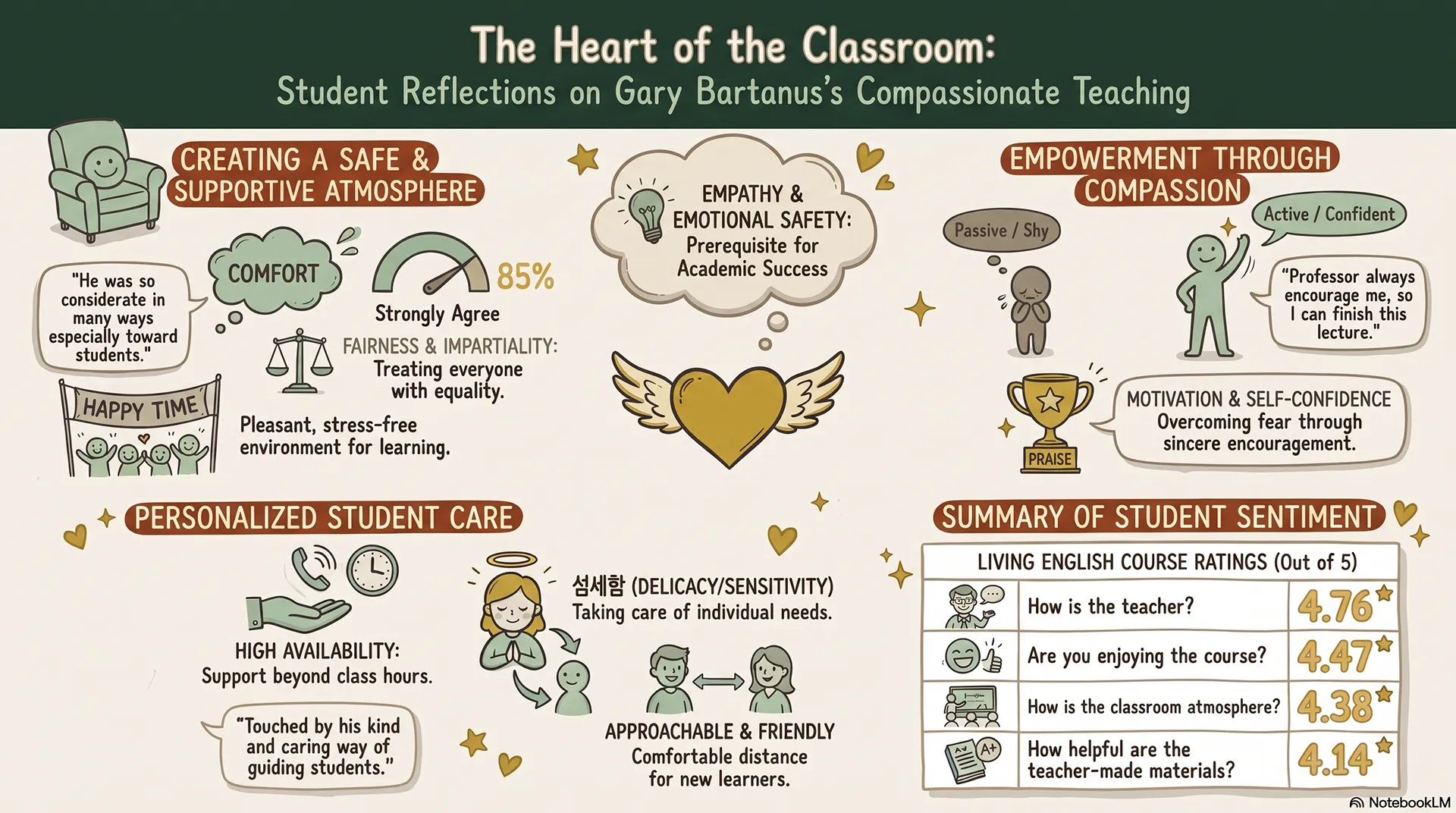
Academic English course ratings · teacher 4.76 · enjoyment 4.47 · atmosphere 4.38 · materials 4.14 (out of 5)
Go Deeper
The Studio
Deep Dive: Gary Bartanus & the Trauma-Informed Classroom
Audio · two-host podcast, AI-generated, Data-driven
Deep Dive is an AI-generated podcast, produced with NotebookLM — the two hosts are synthetic voices, not real people. What’s entirely real is the evidence beneath it. Every observation is drawn from 1,872 student course evaluations of my classes at Hanyang University and Gyeongsang National University (South Korea), recorded across twenty-three academic terms between 2010 and 2016 — the great majority anonymous, portal-administered university evaluations, supplemented by independent course surveys and peer assessments. Artificial voices — real data.
Gary Bartanus, Constructivism, and the Trauma-informed Classroom
“You told me, ‘You don’t need to be fluent when you speak English. Just enjoy your work.’ … Thanks to that answer, I could absolutely enjoy this wonderful class.”
— Minkyo Jeong · collaborative filmmaking project, Fall 2015
Student Assessments of Course
Completed on the final day of the first semester this course was offered · n = 17
“I am very satisfied with this course.”
94%
Agree or Strongly Agree
Strongly Agree — 10 · 59%
Agree — 6 · 35%
Undecided — 1 · 6%
Disagree — 0 · 0%
Strongly Disagree — 0 · 0%
“I would recommend this course to other students.”
95%
Agree or Strongly Agree
Strongly Agree — 12 · 71%
Agree — 4 · 24%
Undecided — 0 · 0%
Disagree — 1 · 6%
Strongly Disagree — 0 · 0%